
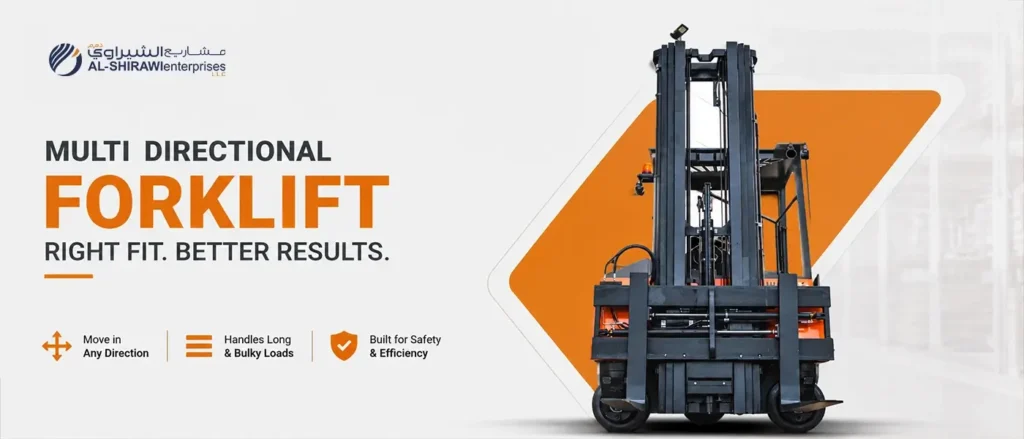
Picture a warehouse team trying to move a 6-metre steel beam through a standard aisle. A conventional counterbalance forklift can lift it easily enough, but turning it, threading it through a doorway, or setting it down precisely against a wall becomes a slow, three-point-turn exercise that eats up floor space and patience. This is the exact problem a multi directional counterbalance forklift was built to solve.
If your operation regularly handles long, bulky, or awkward loads such as timber, pipes, steel profiles, aluminium extrusions, or glass panels, the way your forklift steers matters as much as how much it can lift. This guide explains what a multi directional counterbalance forklift actually is, how the technology works, where it earns its keep, and how to know if it’s the right investment for your site.
A multi directional counterbalance forklift is a forklift truck that can drive forward, backward, sideways, and diagonally without needing to turn or reposition. It combines the stability and lifting capacity of a traditional counterbalance forklift with the manoeuvrability of a sideloader, giving operators a single machine that handles both pallets and long loads.
Standard forklifts steer through their rear wheels and move primarily along one axis: forward and back. A multi directional model uses all-wheel steering, so every wheel can turn independently. The truck can rotate its wheels 90 degrees and travel sideways down a narrow aisle, then switch back to conventional front-loading in seconds, all without the driver reversing or realigning the vehicle.
This is different from a multi directional reach truck, which is typically designed for narrow-aisle warehouse racking and lighter, more contained loads. A counterbalance version, by contrast, doesn’t rely on outriggers or a support leg. Its own weight distribution keeps it stable, which makes it suited to outdoor yards, loading docks, and mixed-surface environments as much as indoor storage.
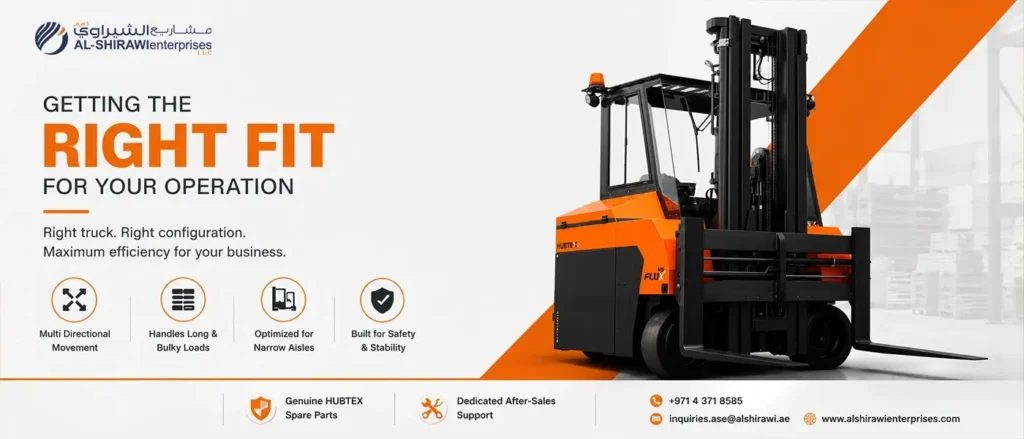
HUBTEX Multi Directional Forklifts
The core of the technology is the steering axle configuration. Most multi directional forklift trucks use a three- or four-wheel chassis where each wheel is independently steerable, controlled electronically or hydraulically from the cab.
| Mode | Wheel Position | Best For |
| Longitudinal (standard) | Wheels straight | General pallet handling, loading trucks |
| Transverse (sideways) | Wheels turned 90° | Carrying long loads through narrow gaps |
| Diagonal / crab steering | Wheels angled | Precise positioning in tight corners |
The transition between these modes happens on the move, without stopping to realign the chassis. On systems like HUBTEX’s 360° HX steering, this switch is smooth enough that operators can go from longitudinal to transverse travel mid-manoeuvre, which cuts down on wheel wear and reduces the time spent repositioning a load.
A quick way to picture it: a standard forklift carrying a 6-metre pipe through a warehouse has to reverse, angle, and inch forward repeatedly to get it through a doorway. A multi directional forklift simply rotates its wheels and drives the pipe through sideways, in one continuous movement.
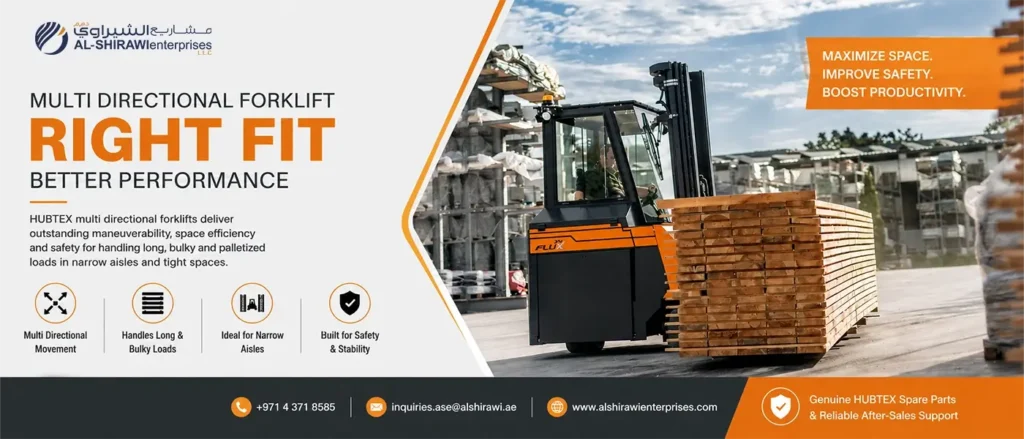
Need one machine for pallet handling and long goods? Explore the HUBTEX Flux 30 counterbalance and sideloader solution.
Not every warehouse needs multi directional capability, and it’s worth being honest about that before specifying one. It earns its cost when a business regularly deals with loads that are long relative to their width or works in facilities where aisle space is limited and can’t easily be widened.
A useful real-world example: one HUBTEX customer, a manufacturer producing amusement park equipment, needed to move steel and stainless-steel tube stock over 10 metres long from warehouse to processing to galvanising. A conventional counterbalance truck needed wide aisles and repeated repositioning to move the tubes safely: increasing both handling time and accident risk from the small contact area between forks and pipe. Switching to a multi directional forklift that works as both a counterbalance truck and a side loader in one vehicle solved the bottleneck without adding a second machine.
If your team’s biggest complaint is ‘we need two different forklifts for two different jobs,’ that’s usually the clearest sign a multi directional model is worth evaluating.
| Feature | Standard Counterbalance Forklift | Multi Directional Counterbalance Forklift |
| Steering | Rear-wheel, forward/backward | All-wheel, forward/backward/sideways/diagonal |
| Aisle width needed | Wider, for turning | Narrower, no turning required |
| Long load handling | Requires repositioning | Moves loads sideways directly |
| Typical use | General pallet handling | Long, bulky, or oversized goods plus pallets |
| Versatility | Single-function | Often replaces two vehicle types (forklift + sideloader) |
The trade-off is usually upfront cost and, depending on the model, a learning curve for operators used to conventional steering. For businesses with genuinely mixed handling needs, though, one multi directional truck can often replace two separate machines, which changes the cost comparison considerably once fleet size, maintenance, and yard space are factored in.
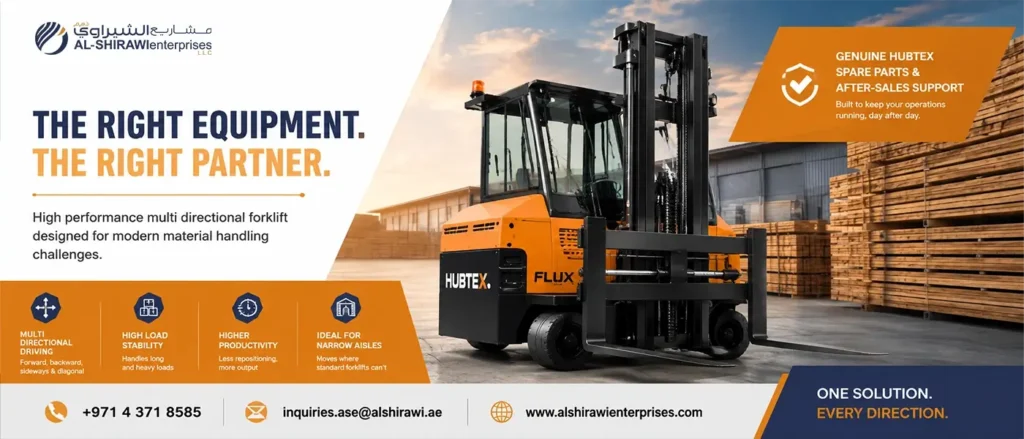
Explore Multi Directional Forklifts in UAE
The HUBTEX Flux 30 is a purpose-built multi directional counterbalance forklift with a 3-tonne load capacity and lift heights of up to 7.5 metres. A few features stand out for day-to-day operation:
For a business handling both palletised stock and long or oversized material, the Flux 30’s dual role as counterbalance forklift and side loader in a single unit is often the deciding factor over running separate machines.
Buyers evaluating multi directional forklift trucks for sale usually land on a few recurring questions before deciding:
Do I need multi directional wheels, or would a reach truck do the job?
If loads stay within standard pallet dimensions and racking is the main constraint, a reach truck may be sufficient and more cost-effective. Multi directional counterbalance models earn their place when load length, outdoor use, or mixed pallet/long-goods handling is involved.
What’s the real training requirement?
Operators familiar with standard forklifts generally adapt within a short, structured training period, since the core lift and load-handling principles don’t change, only the steering modes are new.
How does maintenance compare to a standard forklift?
The additional steering components mean routine servicing matters more, not less. Working with a supplier that stocks genuine spare parts and understands the specific mechanism avoids extended downtime if something needs attention.
Can it work outdoors as well as indoors?
Multi directional counterbalance trucks are generally more suited to mixed indoor/outdoor use than reach trucks, since they don’t depend on smooth warehouse flooring or racking-guided rail systems in the same way.
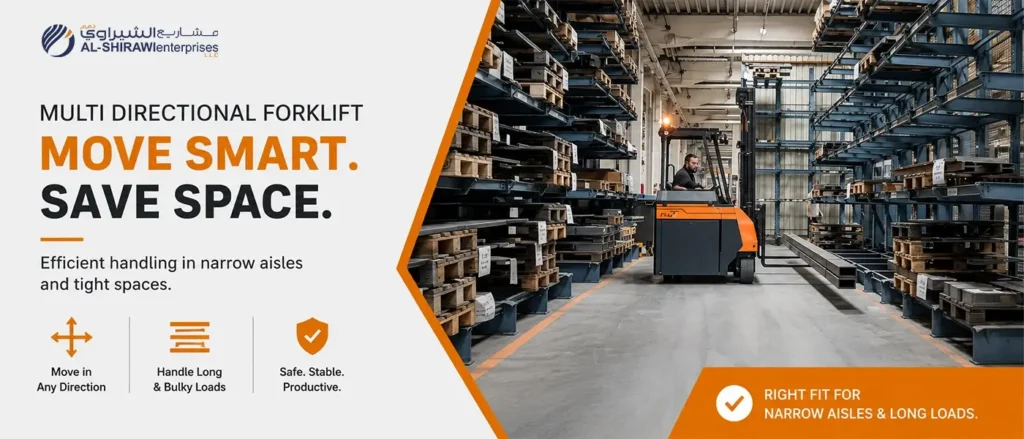
Looking for a versatile 3 ton multi directional forklift? Explore the HUBTEX Flux 30 for handling pallets, steel, pipes, timber and other long loads.
Getting the Right Fit for Your Operation
Specifying a multi directional forklift isn’t just about picking a load capacity off a spec sheet. Aisle widths, door clearances, typical load dimensions, indoor/outdoor use, and how often the truck needs to switch between pallet and long-goods handling all shape which configuration actually pays off.
Al Shirawi Enterprises are the official distributors of HUBTEX in the UAE. Offering the Flux 30 to warehousing, logistics, manufacturing, and industrial operators across the Emirates. Backed by genuine HUBTEX spare parts and dedicated after-sales support to keep the fleet running with minimal downtime. If you’re weighing up whether a multi directional counterbalance forklift fits your site better than a standard truck or a reach truck, our team can walk through your load types and layout to recommend the right configuration.
Get in touch with Al Shirawi Enterprises to discuss the HUBTEX Flux 30 for your operation, or to arrange a site assessment and genuine parts support.
Al Shirawi Enterprises (LLC)
Dubai, UAE
Tel: +971 4 371 8585
Email: inquiries.ase@alshirawi.ae
Website: www.alshirawienterprises.com
A multi directional forklift is designed to travel forward, backward, sideways and diagonally. This allows operators to handle long and bulky loads more efficiently in narrow aisles and confined working areas.
It is commonly used for handling long materials such as steel profiles, pipes, timber, aluminium extrusions, glass panels and other oversized loads. It can also handle conventional palletised goods, making it suitable for mixed material handling operations.
A standard counterbalance forklift primarily travels forward and backward and requires additional space for turning. A multi directional forklift uses all-wheel steering to move sideways or diagonally, allowing long loads to travel through narrower spaces without repeatedly repositioning the truck.
Yes. The wheels can rotate to allow transverse or sideways travel. This is particularly useful when transporting long materials through narrow warehouse aisles, doors and restricted spaces.
Yes. Multi directional forklifts can reduce the space required to manoeuvre long loads because the machine can travel sideways instead of turning the entire load within the aisle.
A reach truck is generally designed for pallet handling and warehouse racking. A multi directional counterbalance forklift is better suited when an operation needs to handle long or oversized materials, mixed pallet loads, or work across both indoor and outdoor environments.
The HUBTEX Flux 30 has a 3-tonne load capacity and offers lift heights of up to 7.5 metres, making it suitable for palletised goods as well as long and bulky materials.
Yes. The Flux 30 combines counterbalance forklift and sideloader functionality in one machine. Its multi directional steering allows it to handle standard pallet work as well as long-goods applications.
Most fleet buyers spend weeks comparing trucks and about an afternoon comparing…
A warehouse manager walks the floor at a Jebel Ali distribution centre…
A driver on the Dubai–Abu Dhabi–Al Ain corridor can easily log ten…

A warehouse manager in Jebel Ali once told us he’d bought a…
Ask most people what a walk-behind sweeper is, and you’ll get some…
Tell us about your requirement, and our team will contact you within 4 business hours.
Share your requirement — our team will reach out shortly.