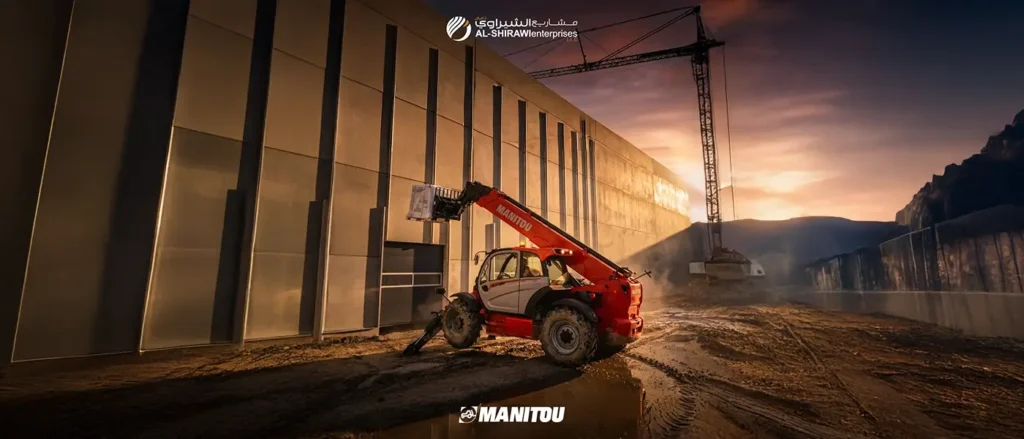
A telehandler is one of the most versatile machines you can put on a UAE construction or industrial site, but “telehandler” covers a much wider range of equipment than most buyers realise. Fixed boom, rotating, heavy-duty and manlift models all fall under the telehandler umbrella, and each is built for a different job.
This guide is for site managers, procurement teams and fleet owners who want a clear picture of what a telehandler does, how it can improve productivity and safety on site, and which type of telehandler actually fits their project. A practical reference covering the main telehandler types, safe operation, and what proper servicing looks like.
A telehandler, also known as a telescopic handler, uses an extending boom to lift, place and stack loads at height and at reach. Because the boom can extend forward as well as up, telehandlers are sometimes described as a telehandler forklift, combining the pallet-handling ability of a heavy duty forklift with the lifting height of a small crane. That combination is what makes telehandlers so useful across construction, industrial, agricultural and logistics sites.
By the end of this article, you will understand the different types of telehandler available, including rotating telehandlers and manlifts, and how to match the right telehandler for sale to your site conditions.
A telehandler is a heavy-duty lifting machine that uses a telescopic boom to extend forward and upward, allowing it to lift, place and stack loads at height and at reach, unlike a machine with a fixed vertical mast.
The boom retracts and extends hydraulically and, on most models, lifts through a wide arc. This gives operators flexibility when placing materials on scaffolding, loading roof structures, or reaching over walls and trenches; tasks that a standard forklift cannot handle.
Telehandlers are commonly fitted with interchangeable attachments, including:
This versatility is why a telehandler is often described as doing the work of a forklift, a crane and a loader combined.
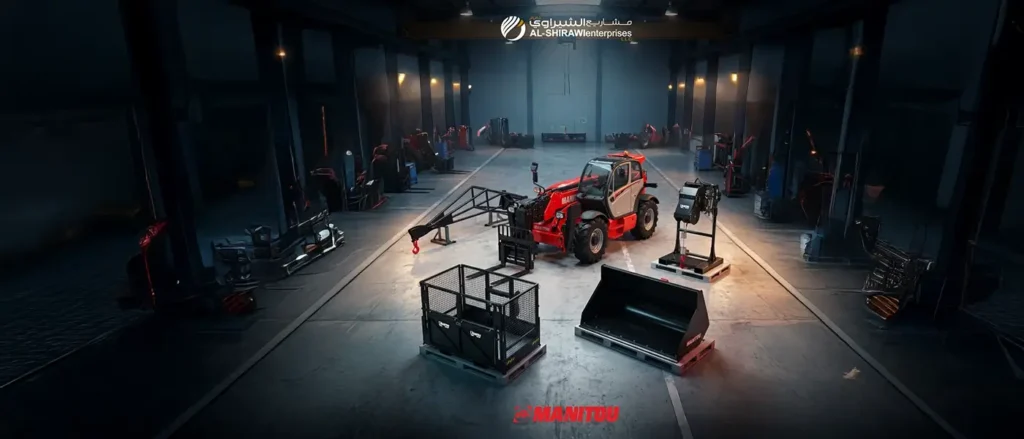
A telehandler improves site performance by reducing the number of separate machines needed, cutting the time spent repositioning loads, and giving operators safe access to height and reach that other equipment cannot match.
Key benefits include:
One telehandler can often replace a forklift, a small crane and a loader for different tasks, reducing fleet costs and site congestion.
The telescopic boom reaches directly to the point of use, cutting the double-handling that slows down projects using fixed-mast equipment.
Larger tyres, high ground clearance and multiple steering modes make telehandlers effective on uneven or unfinished ground.
Outriggers, frame-levelling systems and load-moment indicators help operators lift safely at extended reach.
Switching between forks, buckets, grabs or a work platform lets one machine cover several roles across a project.
Telehandlers are not one-size-fits-all. The right type depends on your lift height, load weight, terrain and whether the job needs 360° rotation or aerial access.
Fixed telehandlers have a stationary chassis with a telescopic boom that extends forward and upward, offering lift heights up to around 18 metres and capacities up to 4,000 kg. Models such as the Manitou MT-X 1840 and MTX-1740 fall into this category, combining a compact footprint with strong load charts for construction and industrial sites. They are the most common telehandler type and suit general material handling, roofing, and structural placement work.
Heavy-duty telehandlers are built for oversized loads, with capacities ranging from around 9,000 kg up to 18,000 kg on reinforced chassis with high-torque drivetrains. The Manitou MHT-X 790 and MHT 1018 models are engineered for ports, steel and precast yards, oil and gas sites, and large-scale industrial operations where standard telehandlers or a heavy-duty forklift would not have the strength or stability required.
A rotating telehandler adds 360° continuous turret rotation to the telescopic boom, letting the operator lift, slew and place a load without repositioning the whole machine. Al Shirawi Enterprises offers a range of Manitou rotating telehandlers including the MRT-X2545 and MRT-X 2260. Working heights typically range from 16 to 25 metres with capacities up to 6,000 kg depending on the models. Many models operate in multiple modes; a telehandler, a winch, or a work platform, making them highly efficient on complex sites where a mobile crane might otherwise be needed.
A manlift, or manlift machine, is a self-propelled aerial work platform used to lift personnel safely to height rather than materials. Articulated and telescopic manlift models Manitou 280TJ and 200ATJ reach working heights of 20 to 27 metres, with platform capacities of around 230 to 350 kg. They are suited to façade work, industrial maintenance, and inspection tasks where workers need stable, controlled access at height alongside, or instead of, a telehandler.
Safe telehandler operation depends on trained operators, correct load calculations, and strict adherence to the machine’s rated capacity chart at every boom angle and extension.
The most common mistakes on site are avoidable: operating without proper certification, estimating capacity by eye instead of checking the load chart, and travelling with the boom raised. A well-trained operator, backed by a properly maintained machine, is the single biggest factor in preventing incidents.
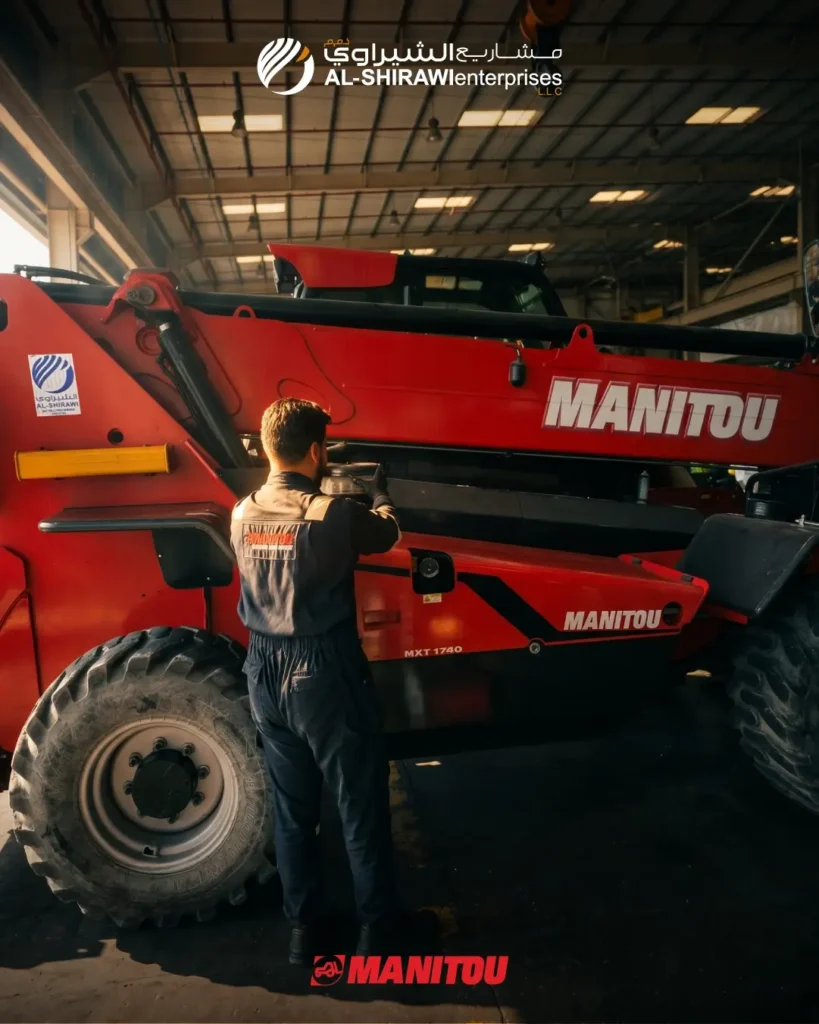
Regular servicing keeps a telehandler performing safely and reliably, and directly affects resale value, downtime and total cost of ownership over the life of the machine.
Because of the extending boom, telehandlers need periodic inspection of wear pads, boom chains and telescopic sections in addition to the usual hydraulic fluid, hose and cylinder checks that apply to any heavy equipment. Rotating telehandlers and manlifts add turret bearings and platform controls to that inspection list.
This is where an authorised dealer matters. Al Shirawi Enterprises, the authorised UAE dealer for Manitou, provides full parts and aftersales support across the entire telehandler range, including the Manitou MTX 1840, giving fleet owners access to genuine components, factory-trained technicians and scheduled maintenance plans.
Start by asking what your site actually needs: lift height, load weight, terrain, and whether the job calls for 360° rotation or aerial access for personnel.
For many construction, industrial and infrastructure projects in the UAE, a fixed telehandler such as the Manitou MTX 1840 covers day-to-day material handling, while a rotating telehandler or manlift adds capability for more complex or elevated work.
A telehandler is far more than a single machine. It’s a category that spans fixed boom models, heavy-duty units, rotating telehandlers and manlifts, each suited to different site conditions and tasks. Matching the right type to your project improves productivity, reduces the number of machines you need on site, and keeps operators safer at height. Whichever telehandler fits your operation, safe practice and consistent servicing are what protect your team, your equipment and your project timeline.
Get Expert Advice From Al Shirawi Enterprises
If you’re weighing up which telehandler for sale suits your next project, our team can help match the right fixed, heavy-duty, rotating or manlift machine to your site conditions and workload. As the authorised UAE dealer for Manitou, Al Shirawi Enterprises supplies the full telehandler range, including the Manitou MTX 1840, backed by full parts and aftersales support.
Contact Al Shirawi Enterprise:
Al Shirawi Enterprises Sheikh Zayed Road, Al Quoz, Dubai, United Arab Emirates P.O. Box 7427, Dubai, UAE
Speak to our team today to arrange a demonstration, get a quote on a Manitou telehandler, or discuss a service plan for your existing fleet.
Enquire on WhatsAppEmail: marketing.ase@alshirawi.ae
A fixed telehandler has a stationary chassis and boom that extends forward and upward, while a rotating telehandler adds 360° continuous turret rotation, letting it lift and place loads without repositioning the machine.
A manlift, or manlift machine, is an aerial work platform used to lift personnel safely to height for tasks like façade work, maintenance and inspections, rather than lifting materials.
It depends on the type. Fixed telehandlers typically reach up to 18 metres, rotating telehandlers up to 25 metres, and manlifts up to around 27 metres, depending on the model.
Operators should hold a recognised telehandler operating certification and complete site-specific induction training in line with UAE workplace safety requirements.
Intervals depend on engine hours and manufacturer guidelines, but daily pre-start checks combined with scheduled maintenance every 250 to 500 hours are standard for most telehandlers.
The Manitou MTX 1840 offers a maximum lift capacity of up to 4,000 kg and a maximum lift height of approximately 17.5 to 18 metres, suited to demanding construction and industrial applications.
Yes. Heavy-duty telehandlers are built on reinforced chassis with higher-torque drivetrains, offering capacities from around 9,000 kg up to 18,000 kg for oversized loads that standard models cannot handle.
Al Shirawi Enterprises is the authorised UAE dealer for Manitou telehandlers, offering the full range from fixed and rotating telehandlers to heavy-duty models and manlifts, with genuine parts and full aftersales support.
A warehouse manager walks the floor at a Jebel Ali distribution centre…
A driver on the Dubai–Abu Dhabi–Al Ain corridor can easily log ten…

A warehouse manager in Jebel Ali once told us he’d bought a…

Ask most people what a walk-behind sweeper is, and you’ll get some…

A fleet manager in Sharjah once told us his biggest fear wasn’t…
Tell us about your requirement, and our team will contact you within 4 business hours.
Share your requirement — our team will reach out shortly.

