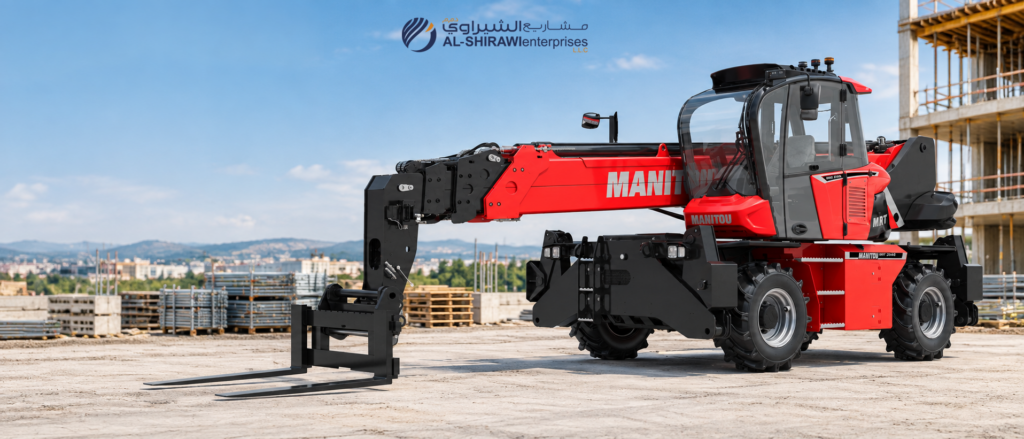
Picture a job site needing a machine to lift materials to height, place them precisely at an angle a standard telehandler can’t reach, and do it without bringing in a mobile crane. This is the exact gap a rotating telehandler is built to fill and understanding when that gap actually applies to your project is the key to specifying the right equipment.
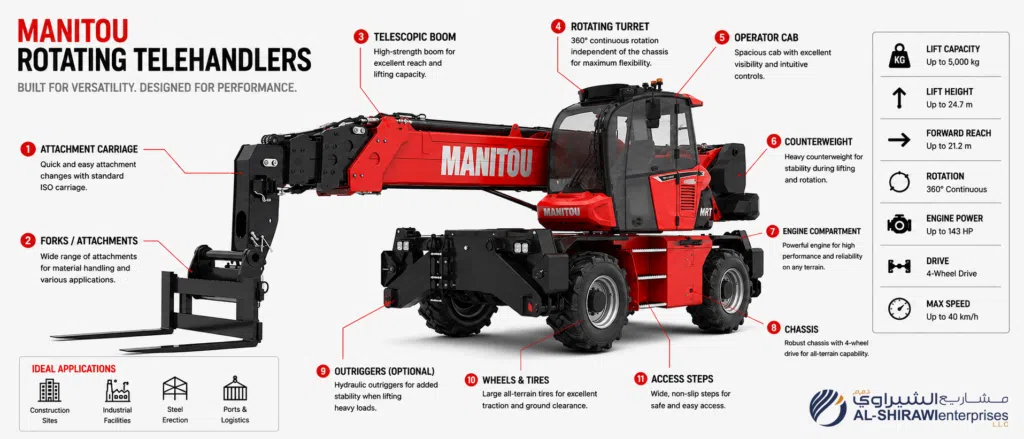
A standard telehandler extends and lifts along a fixed axis relative to its chassis. A rotating telehandler adds 360-degree rotation of the upper structure, independent of the chassis position, closer in function to a mobile crane than a conventional telehandler, but with the compact footprint and versatility telehandlers are known for.
Rotating telehandlers in UAE earn their place on projects where:
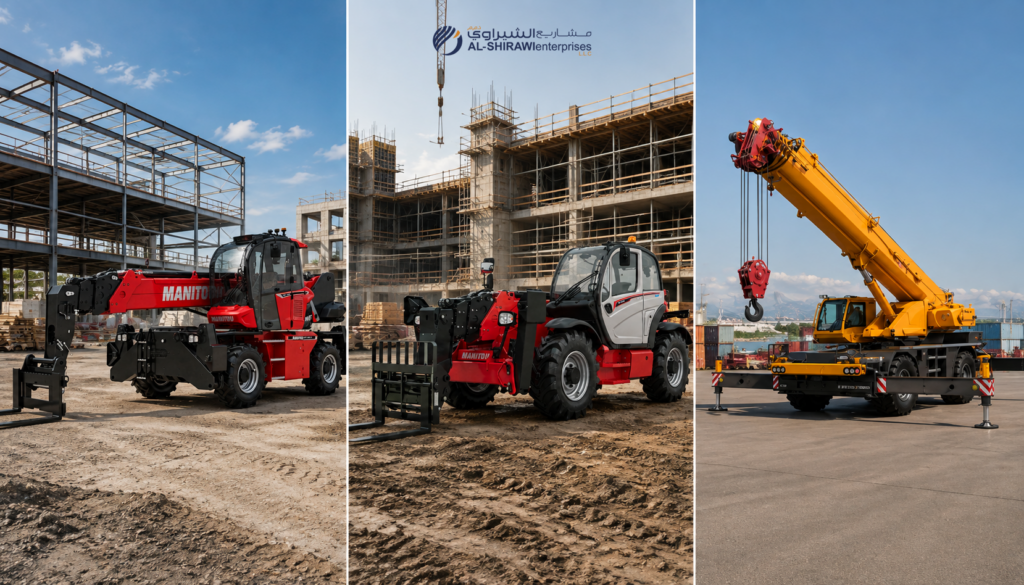
| Machine | Rotation | Mobility | Best suited to |
|---|---|---|---|
| Standard telehandler | Fixed axis | High, self-propelled | General lifting and material handling |
| Rotating telehandler | 360°, independent of chassis | High, self-propelled | Complex-angle lifting, restricted-access sites |
| Mobile crane | 360°, but less mobile on site | Lower, requires setup | Very heavy lifts, fixed lift points |
For many mid-range lifting tasks that don’t require full crane capacity but do require rotational flexibility, a rotating telehandler bridges this gap efficiently, often reducing both cost and mobilisation time compared to bringing a crane onto site.
Rotating telehandlers reduce the need to constantly reposition equipment, which lowers the risk associated with repeated manoeuvring in congested or high-traffic site areas. Fewer repositioning movements also mean faster cycle times for tasks requiring multiple placement angles, directly improving productivity on complex lifting schedules.
Manitou rotating telehandlers, supplied by Al Shirawi Enterprises as the authorised Manitou dealer in the UAE since 2004, are engineered specifically for this kind of demanding, multi-angle lifting work. Models like the MRT-X series offer 360-degree rotation and extended reach, making them particularly suited to high-rise construction where standard telehandlers and mobile cranes both fall short on flexibility or practicality.
If your site regularly involves complex lifting angles, restricted access, or tasks that would otherwise require a mobile crane, a rotating telehandler is worth serious consideration. For simpler, single-direction lifting tasks, a standard telehandler or heavy duty forklift may be the more cost-effective choice.
Considering a Rotating Telehandler for Your Next Project? Let’s Assess Your Site
Our Manitou specialists at Al Shirawi Enterprises can help determine whether a rotating telehandler, standard telehandler, or manlift best suits your job site; backed by genuine parts and full after-sales support across the UAE.
Contact Al Shirawi Enterprise:
Email: marketing.ase@alshirawi.ae
Al Shirawi Enterprises Sheikh Zayed Road, Al Quoz, Dubai, United Arab Emirates P.O. Box 7427, Dubai, UAE
It’s used for lifting and placing materials at multiple angles through 360-degree rotation, particularly on complex or restricted-access sites where repositioning a standard telehandler isn’t practical.
A rotating telehandler offers similar 360-degree rotation but with greater site mobility and a smaller footprint, making it more practical for many mid-range lifting tasks than a mobile crane.
Generally yes, due to the added rotation mechanism and capability, but it can reduce overall project cost by removing the need for a separate mobile crane.
High-rise construction, infrastructure, oil and gas, and industrial maintenance projects commonly use rotating telehandlers for their lifting flexibility.
Yes, as the authorised Manitou dealer in UAE since 2004, we supply the full rotating telehandler range including the MRT-X series, backed by genuine parts and service support.
Some rotating telehandler configurations and attachments support personnel access, though dedicated manlifts remain the standard choice for aerial work platform tasks.

A warehouse manager walks the floor at a Jebel Ali distribution centre…

A driver on the Dubai–Abu Dhabi–Al Ain corridor can easily log ten…

A warehouse manager in Jebel Ali once told us he’d bought a…
Ask most people what a walk-behind sweeper is, and you’ll get some…

A fleet manager in Sharjah once told us his biggest fear wasn’t…
Tell us about your requirement, and our team will contact you within 4 business hours.
Share your requirement — our team will reach out shortly.

