
A driver on the Dubai–Abu Dhabi–Al Ain corridor can easily log ten hours behind the wheel in a single shift, then do it again the next day. Multiply that across a fleet of twenty vehicles and the numbers stop being just about comfort and start being about margin: fuel burn, unplanned downtime, driver turnover, and the cost of a truck sitting in a workshop instead of on the road.
Long-distance operators comparing long-haul trucks in the UAE are not simply shopping for a vehicle. They are selecting an asset that must deliver dependable performance across demanding routes and operating schedules. The specification sheet matters more here than almost anywhere else in the fleet, because a wrong choice doesn’t just cost more; it shows up as fatigue, breakdowns, and missed delivery windows.
This guide looks at the specs that actually move the needle for long-haul operations: cab layout, drivetrain configuration, fuel efficiency technology, and the after-sales support that keeps a truck earning instead of waiting for parts.
Long-haul trucking generally means routes that keep a driver away from base for a full shift or longer. Think Dubai to Abu Dhabi, cross-border runs into Saudi Arabia or Oman, or inter-emirate freight that regularly clocks 300+ km per leg. That differs from distribution-truck operations, where frequent stops, manoeuvrability, visibility, and urban operating efficiency carry greater importance.
The distinction matters because the specs that make a distribution truck efficient – tight turning circles, low cab height for frequent entry and exit – aren’t the same priorities that make a long-haul truck efficient. On long routes, the truck needs to be optimised for sustained speed, driver endurance, and fuel economy over distance, not manoeuvrability.
Fleet operators can compare Scania long-haulage truck models based on axle configuration, gearbox, application, and route requirements.
If part of your fleet handles shorter, stop-start urban work, compare the broader Scania truck range in the UAE before standardising one truck specification across every route.
Fleets with mixed applications can also explore commercial transport and mobility solutions covering long-haulage, distribution, specialised transport, buses, and trailer requirements.
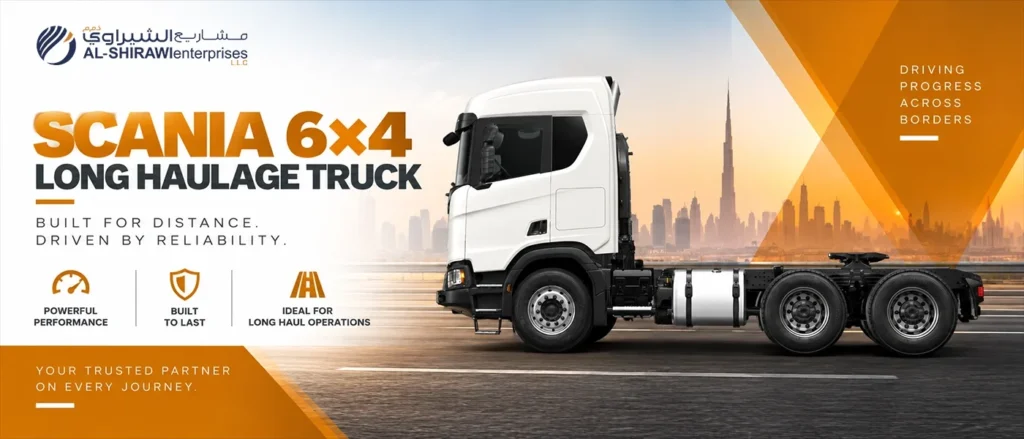
A driver who’s uncomfortable after hour four makes worse decisions by hour eight. Fatigue-related incidents are one of the most preventable causes of downtime and insurance claims in long-haul fleets, and cab design is the first line of defence.
Look for:
Scania’s long haulage cabs are built around this exact problem; ergonomic layouts, smoother gear transitions, and stronger climate control designed for drivers doing long shifts in demanding heat, not short urban hops.
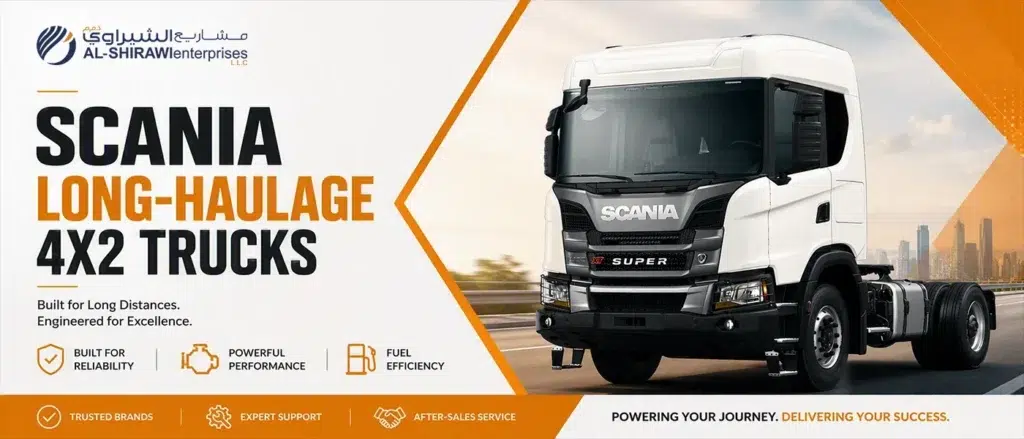
This is usually the first fork in the road for a long-haul buyer, and it comes down to load and terrain rather than personal preference.
| Configuration | Best suited for | Trade-off |
| 6×4 | Heavier loads, oversized cargo, construction or industrial freight, routes with tougher terrain | More traction and stability, generally higher fuel consumption |
| 4×2 | Standard cargo, retail distribution over long distances, freight where payload is moderate | Lighter, more fuel-efficient over distance, less suited to very heavy or uneven loads |
Scania offers both as part of its long haulage range in the UAE through Al Shirawi Enterprises. The Scania 6×4 Long Haulage Truck, built for heavy and oversized freight with the extra traction that comes from the additional drive axle, and the Scania 4×2 Long Haulage Truck, tuned for operators moving standard cargo where fuel economy over distance is the priority. Both run on Scania Opticruise, an automated gear-changing system that shifts faster and more precisely than manual operation; which matters over a ten-hour shift, because it takes one more source of fatigue out of the driver’s hands.
Quick way to decide: if the load regularly pushes toward maximum payload or includes oversized or industrial cargo, 6×4 is the safer spec. If freight is standard cargo and the priority is cost per kilometre over long distances, 4×2 usually wins.
Fuel is typically the single largest operating cost in a long-haul fleet, ahead of maintenance and often ahead of driver wages. A half-litre-per-100km difference in consumption compounds fast across a fleet running thousands of kilometres a week.
A few technologies worth checking for on any long-haul spec sheet:
None of this replaces good driver habits, but a truck that’s engineered for fuel efficiency gives a disciplined driver more room to actually save money, rather than fighting the equipment.
A cheaper truck that burns more fuel or needs more workshop time erases its purchase-price advantage within the first year of long-haul running. Total cost of ownership; fuel, parts, downtime, resale, is the number that actually matters.
Choosing 6×4 across the whole fleet ‘to be safe’ adds unnecessary fuel cost on routes that never carry near-maximum payload. Match the drivetrain to what the truck actually carries most of the time.
Buyers who focus entirely on engine specs and skip cab comfort often see it come back as driver turnover — a cost that’s harder to see on a spreadsheet but shows up in recruitment and retraining.
A truck is only as reliable as the supply chain behind it. Genuine parts availability and service network coverage across the UAE should be part of the buying decision, not an afterthought once the truck is already on the road.
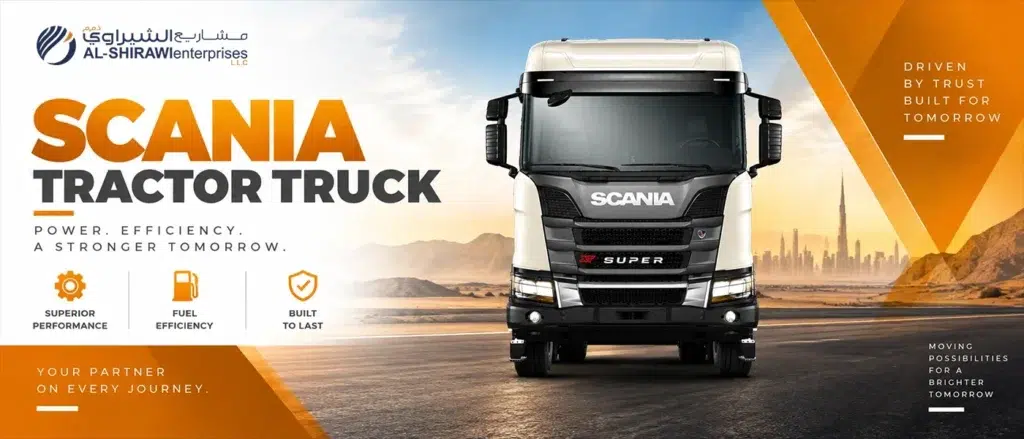
Long-haul economics are decided as much by uptime as by fuel efficiency. A truck that’s fast and comfortable but spends one week a month in the workshop is not a good long-haul asset, regardless of what it costs to fill up.
A few things worth checking before committing to a supplier:
Al Shirawi Enterprises has represented Scania in the UAE since 1981, and its after-sales structure is built around exactly this problem: factory-trained, certified technicians, diagnostic workshops, genuine Scania spare parts, preventive maintenance contracts, and 24/7 mobile service stations across the UAE. For a long-haul operator, that combination; a truck spec suited to the route plus a service network that can actually reach it, is what keeps cost-per-kilometre numbers predictable month to month.
Explore Al Shirawi Enterprises after-sales support
| If your operation looks like this… | Consider |
| Standard cargo, long distances, fuel cost is the main lever | Scania 4×2 Long Haulage Truck |
| Heavy or oversized freight, tougher terrain, stability matters most | Scania 6×4 Long Haulage Truck |
| Drivers doing regular overnight or cross-border runs | Prioritise sleeper cab configuration and climate control |
| Fleet running tight delivery windows with little slack | Weight service network coverage and maintenance contracts as heavily as the spec sheet |
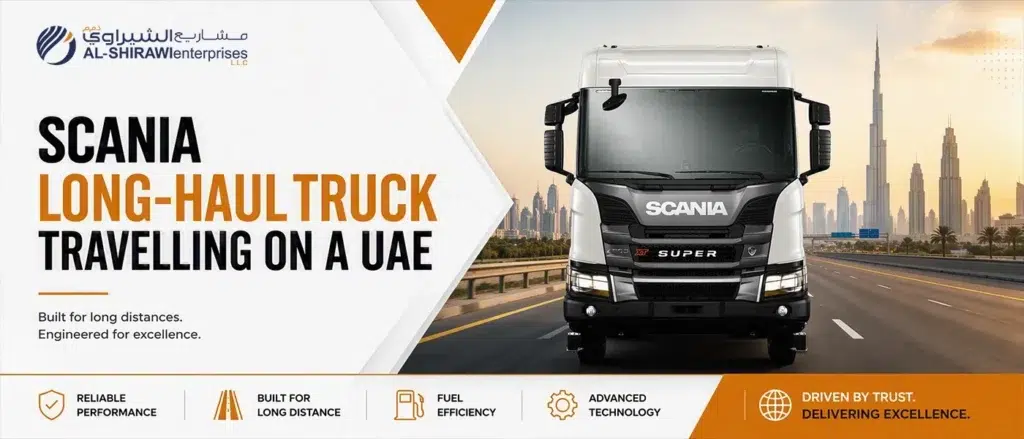
The right long-haul truck depends on what you’re carrying, how far, and how often. Not on a single ‘best’ configuration.
If you’re weighing up a 6×4 against a 4×2, or trying to work out whether your current fleet’s cab specification is contributing to driver turnover, it’s worth a conversation with a team that services what it sells.
Al Shirawi Enterprises has supplied and supported Scania trucks in the UAE since 1981, with both the 6×4 and 4×2 Long Haulage Truck ranges, genuine spare parts, preventive maintenance contracts, and a service network built to keep long-haul fleets moving.
Get in touch on 043718585 or inquiries.ase@alshirawi.ae, or Explore the Scania long-haulage truck range to compare available models, review their configurations, and request a fleet quotation.
Al Quoz, Dubai | DIP | Abu Dhabi | Sharjah | Ras Al Khaimah
Long-haul trucks are specified for sustained highway distance; driver comfort, fuel efficiency over hundreds of kilometres, and drivetrain stability. Distribution trucks are built for frequent stops, tighter manoeuvrability, and shorter routes.
It depends on load. 6×4 suits heavier or oversized freight and tougher terrain; 4×2 suits standard cargo where fuel economy per kilometre is the priority.
Significantly, though indirectly. Fatigue increases the likelihood of incidents and slows delivery times, while poor cab ergonomics contribute to driver turnover, a real cost even though it doesn’t appear on a fuel report.
It’s a GPS-based cruise control system that reads upcoming road topography and adjusts vehicle speed ahead of hills, reducing fuel consumption and improving safety on unfamiliar routes.
Yes, more so than for local distribution fleets. A long-haul truck is more likely to break down away from base, so parts availability and service network coverage across the UAE directly affect how long that truck is off the road.
Yes. Al Shirawi Enterprises, the authorised Scania dealer in the UAE, offers preventive maintenance contracts alongside genuine parts and a 24/7 mobile service network designed to minimise downtime for fleets running long routes.
Focusing on purchase price instead of total cost of ownership. Fuel efficiency, cab comfort, and parts availability usually outweigh the upfront saving of a cheaper spec within the first year of long-haul running.

A warehouse manager in Jebel Ali once told us he’d bought a…

Ask most people what a walk-behind sweeper is, and you’ll get some…

A fleet manager in Sharjah once told us his biggest fear wasn’t…
Picture a warehouse team trying to move a 6-metre steel beam through…

A dusty warehouse floor, loose debris around a loading area or fine…
Tell us about your requirement, and our team will contact you within 4 business hours.
Share your requirement — our team will reach out shortly.

